Sunday, 17 March 2013

Eyes, Bunnies, Neanderthal Extinction


Every week scientists seem to change their mind regarding the cause of the extinction of neanderthals. This week it was their big dreamy eyes, the other day it was rabbits, a while back it was their rubbish childhoods.

In truth, I'm sure most researchers aren't radically changing their minds so much so often, but adding nuances to complex theories. The problem is almost certainly down to hyperbolic science journalism. 

Silent killer.
 From what I understand, there are still a few key competing theories regarding neanderthal extinction: interbreeding, disease, genocide or some general competitive advantage possessed by humans. It's this last factor that causes trouble. As soon as we begin to speculate about the details of a plausible but vague competitive advantage, we open the doors to any hypothesis that sounds feasible. Superior communication? Diverse tools? More effective hunting strategies? Surely any and all of these are possible, but how would we come to any sort of sensible and testable comparison?

Giant eyes, killer bunnies; these guys had a hard time.
This a problem that frequents evolutionary psychology. In evolutionary psychology we look for evolutionary reasons for often highly specific and complex psychological traits and behaviour. But in doing so we run the danger of hysterical hypothesising- rapidly drawing conclusions that are frequently unverifiable. That's not to say there isn't an evolutionary explanation for those traits, but rather that our conclusions need to be moderate and uncertain. Likewise, I don't doubt the possibility of human competitive advantages over neanderthals- as a lay person who am I to dispute this? I also don't doubt the possibility and utility of comparing the plausibility of different adaptations as an explanation for human survival to some extent. However, I find the range of such assured headlines suspicious. I'm sure most scientists in the field take a nuanced approach that avoids such certainty.

Friday, 15 March 2013

Things that are (probably) magic

There are some philosophical questions that seem utterly unanswerable from within a naturalistic framework. These are questions that science just doesn't appear to have the capacity to investigate. These are things that, at least from where we're currently standing, appear to be magic.
  1. Consciousness: Why is there anything at all that it feels like to be a person, or a dog, or a bat? Where does subjectivity fit into the naturalistic framework?
  2. Free Will: Naturalism commonly assumes a causally deterministic universe (or at best, a quantum undeterministic universe, which is hardly an improvement). How then can we freely choose to act?
  3. Morality: How can anything possess inherent value? What does it mean for something to be right or wrong if all that exists is the physical world?
There's an obvious sense in which all three of these "magic things" are linked. Moral action, at least under most systems, requires a degree of free will, and free will would seem to require a degree of conscious awareness. So maybe we should say that there's just one magic thing, perhaps a transcendent soul of some description.

This is all a bit tongue-in-cheek, although there's a serious point to it as well. Rather than just discarding these as "magic things" that naturalistic philosophy cannot investigate, it might be better to simply regard them as ill-formed questions. In fact, scientific progress is being made on the subject of consciousness, but only by breaking it up into a number of smaller, related questions about attention, perception, and so on. Similarly, questions about the cognitive implementation of agency are tractable, even if the fundamental nature of free will is not. And whilst we might not be able to determine why something is right or wrong, we can ask more practical questions about how ethical principles should be applied in the world.

So maybe we should just accept that, at least for the time being, some things appear to be magic, and get on with answering the questions that we can answer.

Sunday, 3 March 2013

Life Without Philosophy

Last Friday I attended a talk by Derek Ball (from the University of St. Andrews), titled "Philosophy Without Truth". His basic claim was that even if philosophical theories were never true, we might nonetheless have reason to accept them. His argument followed the structure of arguments for anti-realism in the philosophy of science, appealing to, amongst other things, the failure of previous philosophical theories and fact that some theories might actually contradict themselves if they were true.

I think that the most interesting point came out in the discussion at the end, where someone suggested that we might want to go for a "pluralism-plus" with regard to the aims of different philosophical disciplines. This would mean that not only might different disciplines have different aims (a possibility that Ball mentioned towards the end of his talk), but that even within a given discipline there might be a number of different competing aims, truth being only one of them.

What might some of those aims look like?

Truth - Obviously we might think it's important that a philosophical theory is true (whatever that might mean).

Scientific Progress - Related to the above, some disciplines/schools see philosophy as being continuous with science, in which case (presuming scientific realism!) they might well aim at truth.

Instrumental Value - On the other hand, we might only care about a theory being in some way "useful", whether that be to scientific progress or in some ethical sense. Pragmatism (as a global description) perhaps falls into this category.

Clarity - Even if it doesn't achieve anything else, a philosophical education certainly enables one to think and reason clearly, and could be valuable for that reason alone.

Being "Interesting" - Towards the end of the discussion I flippantly commented that if we were only motivated by being interesting, we'd be better off becoming fiction writers, but I do actually agree that there can be an aesthetic value to philosophy.

Being Fun - A bit like being interesting, but somewhat broader and perhaps more liable to result in incoherent post-modern ramblings.1

Existential Necessity - Not an aim so much as a motivation, but philosophy asks some pretty mind-bending questions, and perhaps at some level simply pursuing those questions is a necessary component of a fulfilling life.

Winning - The aim of philosophy is to disprove the argument of others while working within the rules of logic.2

I think that all of these are important, and all in some sense contribute to my reasons for pursuing a philosophical career. Some are definitely more important than others though, and if I didn't think that there was at least some instrumental value to what I was doing, I probably wouldn't carry on doing it. On the other hand, I find it hard to imagine a life without philosophy, so perhaps I haven't got much choice in the matter.

This list is by no means comprehensive, so please let me know if you can think of any other aims of philosophy!

1. Inspired by a comment from Krzysztof Dołęga, although he is not responsible for the suggestion that incoherent post-modern ramblings are "fun".
2. Krzysztof also suggested this, albeit as an example of "fun".

Monday, 18 February 2013

Philosophy of [Mind/Psychology/Cognitive Science]

Depending on what mood I'm in, and/or who I'm talking to, I might describe myself as studying either philosophy of mind, or psychology, or cognitive science. So what's the difference? Whilst the terms are often used interchangeably, it seems to me that they each have a slightly variation in emphasis:

Philosophy of Mind: This covers the more traditional metaphysical questions regarding what the mind is, whether it's distinct from the physical, and so on. Up until the mid-20th century this was pretty much your only option. Of the three this is most likely to conduct 'armchair' philosophy, with no reference to empirical evidence.

Philosophy of Psychology: This focuses more on methodological questions about actual scientific practice within psychology, and might be regarded as a sub-discipline of philosophy of science. I would also include 'social cognition', at least as I've been taught it, within this category. Philosophy of psychology is, by necessity, closely engaged with ongoing psychological and neuroscientific research.

[Philosophy of] Cognitive Science: Here the 'philosophy of' prefix is arguably unnecessary, as cognitive science is essentially a fusion of linguistics, philosophy, and computer science. Since its genesis in the 1940s/50s this has become an increasingly dominant paradigm. It tends to focus on relatively fine-grained questions about the structure and instantiation of cognition, and attempts to replicate this in artificial intelligence. Historically cognitive science has tended to be committed to some form of the computational theory of mind, but with the advent of embodied cognition and anti-representationalism this has begun to change.

Now there's obviously a huge amount of overlap between these fields, and it's pretty much impossible to study them in isolation from one another (although some philosophers of mind certainly attempt to do this). Personally I favour the latter two at the moment, yet I believe that it is important to remain aware of the more fundamental issues investigated by classic philosophy of mind.

This is an extremely subjective and provisional analysis, so please let me know if you disagree with my categorisations!

Sunday, 17 February 2013

¡Ai, caramba! Let's not jump to conclusions about chimp working memory

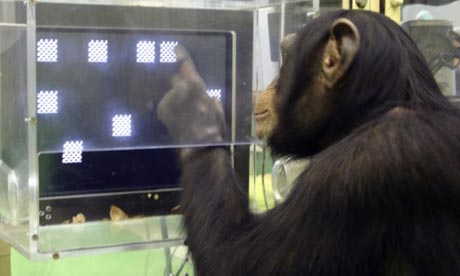
For years, Ai the chimpanzee has been stunning researchers with feats of memory that surpass those of her nearest cousins. Ai, part of the Ai project at Kyoto University, is famously able to remember the location of a series of numbers on a screen within a fraction of a second, and to recall them in their correct sequence (1-19), where it would take you or me in the region of a few seconds. It's really worth checking out.

The Ai project has produced many great papers relating to chimpanzee cognition and behaviour over the years and occasionally the popular press picks up on them. Recently The Independent newspaper declared that, based on research with Ai and her son Ayumu, “Chimpanzees have faster working memory than humans”.

Whilst I am nowhere near qualified to make any sensible judgement on this research, I have to share my hesitation in jumping to such conclusions. In short, I am sceptical that working memory is so simple and binary that from such recall experiments we can say, unequivocally, that chimps have it better than us. Is working memory not involved in all reasoning and comprehension? Is working memory not involved in all verbal and non-verbal communication? Processes involved in these tasks seem, at least in part, more complex in humans- could this not be a relevant factor?

The Articles goes on to claim that,

Professor Matsuzawa suggested that chimps have developed this part of their memory because they live in the “here and now” whereas humans are thinking more about the past and planning for the future.

What does living in the “here and now" mean exactly? If a human individual became better at living in the “here and now” would their working memory improve? 

Ai getting down to monkey business...sigh
It seems to me that all the experiment that The Independent cites shows us is that chimps are better at particular recall tasks, and working memory processes involved with such tasks are more efficient.

It may be prudent from here to theorise that the reason why this is the case is that there is some trade off in humans between “present” memorisation and recall capacity, for other reflective and future considering capacities (which surely involve working memory at some level). This is far more conservative than claiming that chimps unequivocally have better working memory because they “live more in the present”.

I'm guessing part of the problem is sloppy science journalism. It would be interesting to hear in more depth what conclusions the team at Kyoto draw about working memory.

Sunday, 3 February 2013

The evolutionary implausability of outlandish alien cognition

Contemporary arguments for (and against) the extended mind hypothesis (eg. Sprevak 2009) regularly invoke hypothetical aliens with outlandish forms of internal cognition. Sprevak asks us to imagine an alien that stores memories "as a series of ink-marks" (ibid: 9). This is meant to be functionally equivalent to the case where someone 'stores' their memories in an external diary. The point is that, in order to preserve multiple realisability and the Martian intuition, we are forced to accept that both the alien and the diary-user constitute cognitive systems, with the only difference being that the latter extends beyond the biological brain.

Baby Martian?

In another example, this time intended as a reduction ad absurdum of functionalism and the extended mind, Sprevak proposes an alien with an innate, internal cognitive sub-system that calculates the exact date of the Mayan calendar (ibid: 21). Again, his point is that there seems to be no functional difference between this sub-system and the one that he claims to have installed on his office computer1. Ergo, his extended mind includes this implicit knowledge of the Mayan calendar.

Ignoring for the moment any questions about the extended mind per se, we should question the plausibility of these kinds of aliens. In each case, but especially the second, it seems that our aliens would possess remarkably over-specialised brains. The ink-jet memory system seems cumbersome, and the Mayan calender calculator is an extremely niche-interest device, one that would probably never see any use. In both cases it is difficult to imagine how or why such a cognitive architecture would have evolved.

This doesn't constitute a counter-argument, as regardless of any evolutionary implausibility Sprevak's aliens serve their rhetorical purpose. However it's interesting to note that much of Clark's own use of the extended mind is intended to highlight the way in which human brains off-load these kinds of specialised skills on to the environment (see his 2003), meaning that we are precisely the kind of generalists that these aliens aren't. Perhaps it's important not to get too caught up with outlandish aliens when we consider the extended mind, and return to the much more homely (and relevant!) examples which it was originally intended for.


1. I have a meeting with him in his office tomorrow, so I'll try and check if is true...

References
  • Clark, A. 2003. Natural Born Cyborgs. Oxford: OUP.
  • Sprevak, M. 2009. "Extended cognition and functionalism." The Journal of Philosophy 106: 503-527. Available at (and references to) http://dl.dropbox.com/u/578710/homepage/Sprevak---Extended%20Cognition.pdf

Sunday, 27 January 2013

Meaning is User Relative

The dominant paradigm in cognitive science and philosophy of mind is the computational theory of mind (CTM). In its simplest form this theory states that the mind is essentially a device that takes inputs, performs a series of operations on them, and gives us an output. This process is known as a computation, and it is also what the digital computer sitting in front of you does. This is obviously no coincidence, as CTM and computer science have developed alongside one another since the 1950s.

Cue hackneyed image of 'mind as computer'

One major criticism of CTM is that it seems unable to account for meaning or semantic content. Any given computational process can be fully described in terms of the symbols that it operates on, the syntax, along with the rules that govern those operations. Whilst we do bestow meaning on to the symbols that our digital computers operate on, that meaning appears to be entirely relative to us, the user. It does not appear to be inherent to the symbols themselves, and in fact there is an infinite range of interpretations that can be given to any set of symbols (Pylysyhn 1986: 40). The worry is that if the mind is a computer, there would be no (inherent) semantic content to our thoughts.

This might turn out to be correct, which would mean that our mental states only mean anything relative to an observer. My mental representation of the blue sky outside of my window might be interpreted entirely differently by an alien scientist scanning my brain. To it, that mental state might simply represent a complex calculation, or a nostalgic yearning for the Sirius system. This, in fact, is a major plot point in The Hitchhiker's Guide to the Galaxy, where (SPOILER ALERT) the Earth turns out to be a giant supercomputer designed to calculate the Ultimate Question of Life, The Universe and Everything - the answer to which I will not reveal to you at this time.

This was the first attempt.

So what about my own interpretation of that mental state as representing a blue sky? That would have to be relative to me, as the 'user' of my own mental computer. What exactly this means, or if it even makes sense to say that I could be interpreting my own mental states, gets very complicated, very quickly. Aside from anything else, it raises questions about the nature of consciousness and the self, both of which are extremely contentious topics. Still, I see nothing wrong with saying that semantic content might be entirely user-relative, both in the case of the digital computer and that of the brain-bound one.


References
  • Adams, D. 1979. The Hithchhiker's Guide to the Galaxy. Pan Books.
  • Pylyshyn, Z. 1986. Computation and Cognition. MIT Press.