Tuesday, 6 November 2012

Functionalism reconsidered

I've long considered myself to be a functionalist about mental states such as belief and pain. Functionalism is the theory that mental states should be identified not by their physical instantiation but by their functional role, i.e. the role that they play within a given system. The classic example is pain, which is said to be defined by behaviours such as flinch responses, yelling out, and crying (and perhaps a particular kind of first-person experience). One of the main motivations for functionalism is the "Martian intuition" - the intuition that were a silicon-based Martian to exhibit pain-behaviour, we would want to say that it is in pain, despite it lacking a carbon-based nervous system like our own. A less exotic intuition is that an octopus or capuchin monkey can probably feel pain, despite the exact physical instantiation of this pain differing from our own.


Martian octopus, perhaps in pain? 
(with permission from Ninalyn @ http://studiodecoco.tumblr.com/)

However I'm now beginning to suspect that there might be more than a few problems with functionalism. For starters, functional states are often defined as being those that are "relevantly similar" to an imagined paradigm case - thus, a Martian who screamed and recoiled when we punched might be said to be in pain, but one that laughed and clapped its hands (tentacles?) probably wouldn't. This is fine up to a point, especially in seemingly clear-cut cases like the above, but what should we say when we're faced with the inevitable borderline case?

Whether or not fish can feel pain seems to be a case like this. Research into fish pain behaviour is contentious - whilst fish exhibit apparent pain behaviour, they have only recently been shown to exhibit more complex pain avoidance behaviour that might be thought essential to pain. The problem is not just a lack of evidence either, there's a more fundamental lack of clarity about how exactly we should define the functional role of pain, or indeed any other mental state.

Having said that, the problem isn't limited to the functionalist account of mental states. Biological species appear to form vague natural kinds, a problem which has motivated the idea of homeostatic property cluster kinds, categories of kinds that share some, but not all, of their properties. So we maybe we could say that functional kinds, such as pain, are a category of HPC kinds. That still wouldn't necessarily give us a straight answer in genuine border-line cases, but at least we'd have good reason to think functional roles might sometimes pick out genuine kinds (albeit perhaps not natural kinds)

The problems don't stop there though. By arguing that it entails a radical form of cognitive extension, Mark Sprevak has pushed functionalism to its logical extreme. If he is correct then being a functionalist would commit you to apparently absurd conclusions,1 such as that the entire contents of the Dictionary of Philosophy sitting on my desk form part of my cognitive system, or that my capacity for mental arithmetic is bounded only by my access to electronic computing power. I think there might be a way for functionalism to avoid the full force of this argument, but it comes with its own problems and costs.

Essentially what the functionalist needs to do is to stop talking about cognition and mental states as though they were one kind of thing. They're not, and rather than lumping memory, personality, beliefs  and so on into one unitary framework, we need to look at giving finer-grained functional descriptions in each case. This might even mean getting rid of some mental states, such as belief, or at least admitting that they're more complex than we first thought. This approach will still entail some degree of cognitive extension, but hopefully in a more subtle and intuitive way. So whilst it might not be true that the contents of the Dictionary are part of my 'cognitive system', they may nonetheless form part of a belief-like system, albeit one that functions differently to my regular belief system. 

Would this still be functionalism? In a sense yes, because it would maintain a degree of multiple realisability, only at a more fine-grained level. So a Martian with a silicon brain might have beliefs, but equally they might have something more akin to the belief-like system that is constituted by me-and-the-Dictionary. The problem with functionalism is that it tends to reify our folk intuitions about mental states, and we need to remember that these might not be entirely accurate. I suppose I'm beginning to lean towards a form of eliminativism, although I still think that there's room for an instrumentalist account of functional roles. 


1. I say "apparently" because I'm not entirely convinced that one shouldn't just bite the bullet and accept these conclusions. That's probably a post for another day though.

Saturday, 13 October 2012

Merleau-Ponty, Wittgenstein, and philosophical mysticism

I study embodied cognition, an emerging field which has taken considerable inspiration from the phenomenological work of the likes of Merleau-Ponty, Sartre, and Heidegger. As such, I've been attempting to get to grips with phenomenology, which given my analytic, Anglo-American philosophical education, is a somewhat odd experience. Phenomenology, broadly speaking, was a reaction against both empiricism and idealism, placing primary emphasis on "lived experience" and the act of perception. Merleau-Ponty in particular also focused on the interaction between the perceiver and the world, and it is this sense of "embodiment" that embodied cognition has most taken to heart.

Merleau-Ponty: grumpy

However there is another side to phenomenology, one which has the potential to be profoundly inimical to the whole project of cognitive science, embodied or not. There is evidence to suggest that Merleau-Ponty, at least, understood phenomenology to be far more than a modification of our psychological methodology. His most famous work, Phenomenology of Perception, is  littered with cryptic remarks that undermine any attempt to read it as a work of empirical psychology. He explicitly states that it is a work of transcendental philosophy, aimed at achieving "pre-objective perception". It is not at all clear what this might be, or even whether it can be expressed in words. Throughout the book (which I'll admit I haven't yet read), there is apparently a sense in which many things go unsaid, perhaps even things which will "only be understood by those who have themselves already thought the thoughts".

Wittgenstein: even grumpier

That sounds familiar. The above quote comes from the introduction to Wittgenstein's Tractatus (which I have read, although I won't claim to have understood it). Both Wittgenstein and Merleau-Ponty seem to be struggling to express the unexpressable, and both, perhaps, ought to be read as "anti-philosophers", whose mission is not to solve any great problems but to help us understand why there never were any problems in the first place. This is certainly the opinion of a psychology lecturer I know who, under the influence of both Wittgenstein and Merleau-Ponty, seemed shocked that us philosophers might still be trying to solve the "problem" of consciousness. Whilst I think this is somewhat arrogant (and ignorant), it is true that both Merleau-Ponty and Wittgenstein regarded analytic philosophy as curiously misguided, tied up in knots of its own creation.

In light of which it may seem odd that half a century later analytic philosophy continues to venerate Wittgenstein, and that analytic philosophy of mind, or at least a certain strand of it, has recently adopted Merleau-Ponty as something of an idol. If both or either of them were right, surely we're completely missing the point? In fact I don't think this should worry us too much. Neither Merleau-Ponty nor Wittgenstein were perfect, and much of what they wrote may have been as confusing to them as it is to us. What is important is to pay attention to the issues that they do highlight, and to take to heart anything that does make sense to us. Daniel Dennett takes this approach with regard to Wittgenstein (in Consciousness Explained and elsewhere), and Shaun Gallagher and Dan Zahavi seem to be doing something similar in The Phenomenological Mind, where they attempt to apply phenomenological insights to contemporary cognitive science. Regardless of whether or not either Mearlea-Ponty or Wittgenstein would have approved, I find this approach extremely useful, and phenomenologically speaking, perhaps this is all that should matter. It is, after all, my lived experience, not Merleau-Ponty's!

(Some credit should go to the phenomenology reading group at the University of Edinburgh, with whom I discussed much of the content of this post. Any errors or misunderstandings, however, are entirely my own.)

  • Dennett, D. 1991. Consciousness Explained. Little, Brown & Company.
  • Gallagher, S. & Zahavi, P. 2008. The Phenomenological Mind. London: Routledge.
  • Merleau-Ponty, M. 1945/1962. Phenomenology of Perception. London: Routledge.
  • Wittgenstein, L. 1921/1991. Tractatus Logico-Philosophicus. New York: Dover.

Thursday, 4 October 2012

"To Squeak and To Squeak Well Are Two Different Things"


 I'm not very much fun at parties. In a recent discussion I overheard regarding a friend's pet guinea pig and their “speaking” to another, I didn't have the sense to ignore it, but decided to ruin a perfectly amiable encounter into a debate about animal communication in which everyone left feeling no more satisfied with life.

On a number of occasions, mostly amongst non-philosophers, I've noticed a common response to a denial of language amongst non-human animals is a dismissive “well how do you know!?”. In an accusatory tone, they question how you could possibly think yourself so arrogant as to make claims about the inner workings of a small furry yet impenetrably mysterious rodent. As a matter of fact I think there's a large consensus amongst most philosophers and scientists that the vast majority, and probably all, non-human animal species are incapable of something equivalent to language (there is of course disagreement about the communicative abilities of primates and some other species). It's worth emphasising to people what is really being said, or not said, when claiming animals "aren't really speaking”, but instead partaking in other, admittedly complex, often not well understood forms of communication. 

It's important to realise that when I say guinea pigs don't have language, I'm not implying...

1. Cartesian Certainty. I don't know for 100% per cent, bet your sweet bippy that guinea pigs don't have language. Neither am I certain lampshades don't have language. Neither am I certain guinea pigs aren't made of cheese. But this sort of Cartesian doubt is as relevant to the question of language capacity, or inner mental activity of any kind, as it is to whether you're all in my head, or the world is a computer-simulated reality run by exploitative machines. In other words, it isn't relevant at all. Not to ordinary daily discourse. Hyperbolic doubt has its place, but it's not really a convincing argument against a particular theory. I don't know guinea pigs aren't really communicating in language, not for certain. But I believe they don't, based on certain inferences given certain empirical data. 

Neither am I saying...

2. Guinea pigs are rubbish. I'm under the impression that a common underlying feeling amongst layfolk is that by claiming animals aren't really “talking” when communicating, I'm somehow being disrespectful.That by denying them language I'm not only arrogant, but attacking their worth. It's as if not being able to communicate with language morally equates animals closer to a packet of Wotsits than a human. One clearly doesn't necessarily imply the other. Of course even if I did think that lack of language ability carried important moral ramifications (and truth be told I do think there is something to that thought), that wouldn't constitute an argument against my initial premise. It's just an implication you don't like.

Mr Tiddles. Less talk, more fluff.
The ascription of communicative abilities within other species must be an empirical question, in so far as once we've sorted out (theoretically) what we're looking for, it's an empirical question as to whether we find them in other species. If it's not, ultimately, an empirical question, I fail to see how we avoid naval gazing ponderment about what Mr Tiddles is really communicating to Fluffy Features.

I think the same extends to broader issues of mental life. Consciousness is an obviously more complex topic than language, lacking anything close to agreement on how we should use the word. But I do think that once we are more clear about what we're talking about, if we ever get there, ascription of consciousness will become more and more an empirical issue.

An important caveat: It is of course entirely possible that our empirical questions cannot practically be answered because of limits to our methods, or because we never manage to coherently establish the theoretical framework. Whilst whether or not Mr Tiddles is communicating in language is an empirical matter, it could be the case that we have insufficient means to pursue the investigation- though in fact with language we have some well established criteria. It is for more plausibly an issue with consciousness and its related issues. It strikes me that it is for insufficiencies within the theoretical understanding, and disagreements over empirical ground world, that we have so much disagreement e.g. with ascription of theory of mind to non-humans.

HPCK and Modal Representations

It's been a busy month, moving into a new flat and starting an MSc. I'm studying full time again, which in terms of blogging is a mixed blessing - lots of material, but very little time.

It's nice when you can combine two previously isolated ideas, and that's what I'm going to try and do today. One comes from the philosophy of science, Boyd's "homeostatic property cluster" theory of natural kinds, and the other is an idea from the philosophy of mind, that our mental images might not be entirely separate from our sensory perception.

I'll start with modal representations, because they're probably simpler. A mental representation is basically a mental state that stands for some part of the external world (Clark 1997: 463), whatever we take that to mean. Mental representation is a thorny topic, but all I'm interested in here is one aspect of the issue: whether such representations are composed of sensory information (modal) or are purely abstract (amodal). For example, does our representation of a sunny day call to mind the pleasant feeling of the sun on our skin, or do we somehow comprehend it in isolation from any sensation? For the previous century (analytic) philosophers tended to pick the latter option, no doubt influenced by classical logic, but some (relatively) recent experiments have questioned that assumption. It seems that there is a systematic connection between representations and the sensory qualities of what they represent, as demonstrated by experiments such as those conducted by Zwan, Stanfield & Yaxley (2002) and by Glenberg & Kaschak (2002). The implications of these experiments are still being debated, but one interpretation is that our representations (and by extension, our concepts) are composed of bundles of modal (sensory) data, rather than discrete, amodal definitions.

This is where Boyd comes in. His theory is a form of realism about natural kinds, but I think that it shares some interesting similarities with the idea of modal properties. Motivated by the messiness of biological kinds, Boyd characterises a natural kind as sharing a cluster of properties, none of which are necessary or sufficient. These kinds are rooted in the causal structure of the world, and are thus real, but they allow for the flexibility that is necessary when it comes to biological kinds. Given that our access to kinds is mediated by our senses, I think it might make sense to identify the modal bundles that I described above with Boyd's property clusters. Our concept or representation of a cow might consist of the vague appearance of a cow, the smell of cow dung, and the monotonous sound they make - and this will in some sense correspond with (at least some of) the properties in the natural kind cluster "cow". Boyd's point is that there doesn't have to be an exact matching for every instantiation of a natural kind, so everyone's perception of cow's can (and will) be subtly different.

I still haven't quite got to grips with Boyd's theory, and I'm not sure how much he would support this idea, but I think it could allow for an evolutionary justification of how classify natural kinds. This would be similar to Quine's empiricist position (see his 1969), and might not be as realist as Boyd would like.

  • Clark, A. 1997. "The Dynamical Challenge." Cognitive Science 21(4): 461-81.
  • Glenberg, A. & Kaschak, M. 2002. "Grounding language in action." Psychonomic Bulletin and Review 9: 558-65.
  • Quine, W.V.O. 1969."Natural Kinds." In Ontological Relativity and Other Essays. New York and London: Columbia University Press.
  • Zwan, R., Stanfield, R. & Yaxley, R. 2002. "Language comprehenders routinely represent the shape of objects?" Psychological Science 13: 168-71.

Sunday, 2 September 2012

Pragmatic Structural Realism

I'm slowly making my way through Everything Must Go (Ladyman et al 2007), and it's honestly been a breath of fresh air - clarifying, and to some extent answering, several concerns about the philosophy of science that I've been harbouring for some time. It's led me to a version of what Ladyman et al call "ontic structural realism" which I'm tentatively referring to as "pragmatic structural realism". I haven't finished the book yet, so bear with me if this doesn't make any sense, or if I've got something wrong.

Put very simplistically, there is a tension between two broad approaches to science: (constructive) empiricism and (scientific) realism.1 The former states that we should take our scientific theories to be no more than adequate descriptions of the phenomena under investigation, whilst the latter commits science to the literal truth of its theories, and by extension to the existence of the unobservable entities that they describe. For example, the realist is committed to the actual existence of sub-atomic particles, whilst the empiricist will merely use them as part of the description of a contingently accurate theory, without making any judgement as to whether or not they exist.2

Both approaches appear to be flawed (although in ways more complicated than the following paragraph might suggest). Realism is committed to the existence of entities that are likely to turn out not to exist, or not to exist in quite the way that we thought they did. As science progresses, some of these entities become redundant, implying a level of discontinuity between theories that in practice is not manifested. Empiricism, meanwhile, struggles to explain why these entities have any explanatory power, if in fact they're not real (it also risks descent into total relativism). Ladyman et al present structural realism as almost a dialectical synthesis of these two approaches, but for now I'll simply try and break down my own understanding of it.

Realism: Scientific theories do attempt to describe some underlying reality, although of course they are often wrong. Contra empiricism, they are more than just a conveniently accurate account of observable phenomena.

Structural: However, it is not unobservable entities per se that these theories are committed to, but rather the structural relationships between them (if indeed they exist at all). This structure is what underlies reality, and is what science seeks to describe. Whilst theory change requires abandoning some entities, the structure of the previous theory can be retained. Thus, Ladyman et al describe how both successive theories and theories at different explanatory levels can be related in terms of mathematical structure rather than direct one-to-one mapping of entities and propositions (2007: 118).

Pragmatic: Science is an ongoing process, and so we must recognise the commitments of our current theories as pragmatic place-holders rather than absolute certainties. These theories are our best guess at the structure of reality, and we adapt them as new evidence becomes available. Furthermore, our commitment to structural realism is itself pragmatic, motivated by our belief that it best describes actual scientific (and epistemic) practice.

How is this relevant to the philosophy of mind? Well, for one thing I'm keen to make sure that my understanding of the mind is based on an accurate understanding of science. It's important to ensure that we know what we're on about when try to describe the physical instantiation of the mind. On one level this calls for an understanding of psychology and neuroscience, but on another it means coming to grips, at least in basic sense, with physics. All science essentially boils down to physics of some description, and even if we're quickly going to abstract away from that fundamental level, I think we need to understand it first. Otherwise our entire project is going to rest on faulty foundations.

James Ladyman strikes me as someone who's got a very clear grasp of both contemporary science and the muddled attempts of philosophers to try and make sense of it. His 2010 paper (with Don Ross) on appeals to scientific practice in the extended mind debate really struck home for me, and Everything Must Go is more of the same, although heavy going at times. I'm looking forward to hearing him speak at this conference in a week's time, and I'll maybe report back with some further thoughts after that.

1. This terminology is somewhat misleading, as strictly speaking scientific realists are also empiricists. The difference lies in what they believe to exist, not how they advocate studying it.
2. Complicating things further is the apparent failure of modern philosophy to appreciate the nature of contemporary physics. We tend to talk of physics as though it studies discrete, although very small, objects. According to Ladyman et al this is incorrect, and more importantly philosophically unhelpful.
  • Ladyman, J., Ross, D., Spurrett, D. & Collier, J. 2007. Everything Must Go. Oxford: OUP.
  • Ross, D & Ladyman, J. 2010 "The Alleged Coupling-Constitution Fallacy and the Mature Sciences." In The Extended Mind, ed. Menary. Cambridge, MA: MIT Press.

Friday, 31 August 2012

Taking an Embodied Approach to Thought Experiments

Embodied cognition, at least in its more radical guises, argues that to truly understand cognition we must look not only at the brain, but also the body and the external world. Whether or not this principle can also be applied to consciousness is a contentious topic (see, for example, Clark 2009), but at the very least it would seem to offer a new approach to several of the classic "consciousness" thought experiments. I've already discussed Frank Jackson's "Mary" experiment in light of embodiment, but today I'd like to consider a few others, and see what general lessons we can draw.

My thoughts on this were prompted by reading Noë (2007), who spends some time discussing the hypothetical isolation of a brain, and what, if anything, it would experience. This is in the context of the search for a neural correlate for consciousness (NCC), a region (or regions) of the brain that is sufficient for conscious experience. Neuroscience is often implicitly committed to the existence of a NCC, and several philosophers are explicitly committed to it, advocating what Noë terms the Neural Substrate Thesis: "for every experience there is a neural process [...] whose activation suffices for the experience" (ibid: 1). If the Neural Substrate Thesis (NST) is correct, then neuroscience will eventually discover a NCC.

Noë focuses on two philosophers who advocate the NST, Ned Block and John Searle. Conveniently, both Block and Searle have also made important contributions to the corpus of philosophical thought experiments. Noë's main point is that focusing exclusively on the brain as the seat of consciousness can in fact be very counterintuitive, to the point of rendering some thought experiments almost incoherent. He demonstrates this with a discussion of the following "duplication scenario" (Noë 2007: 11-15), at least inspired by (if not attributed to), Block:

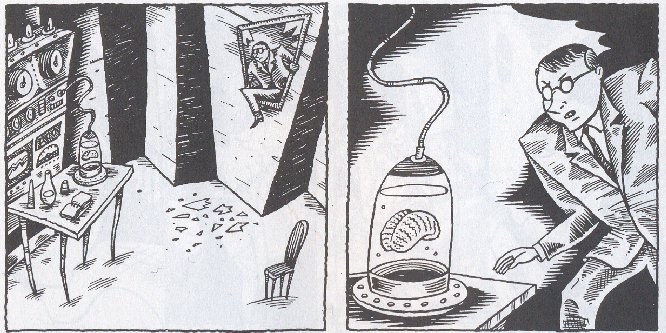
We are asked to imagine that my brain has an exact duplicate, a twin-brain that, if NST is correct, will undergo the exact same conscious experience that I do. Furthermore, if NST is correct, then provided that this brain continues to mimic my own, it doesn't matter what environment we place it in. It might enjoy an identical situation to my brain, or it might be stimulated just so by an expert neurosurgeon, or it might even be dangling in space, maintained and supported by a miraculous coincidence (see Schwitzgebel's discussion of the disembodied "Boltzmann Brain"). In the first couple of cases, Noë agrees that my twin-brain might well be conscious, but only by virtue of its environment (2007: 13). The final case, what he calls a "disembodied, dangling, accidental brain" (ibid: 15), seems to him to be verging on the unintelligible, and I can see his point. At the very least, it is surely an empirical question whether or not such a brain would be conscious, and one that we have no obvious way of answering.

I'm not really sure what's going on here.
 
These cases reminded me of the classic brain-in-a-vat thought experiments. I've previously held that a brain-in-a-vat would be conscious, and I still do - but with one important caveat. Its only conscious by virtue of the vat itself, and all of the complex stimuli and life-support that it is presumably receiving. If it were simply floating in suspended animation, without any input whatsoever, then I'm not so sure that it would be conscious (or at least not in any familiar sense). That is to say, the brain is not itself conscious, but the extended cognitive system that comprises brain, vat and computer probably is.1

Similar reasoning can be applied to Searle's Chinese Room thought experiment. Clearly the man inside the room doesn't understand Chinese, but that's not the point. The extended cognitive system that is composed of the man, his books, and the room, does seem to understand Chinese. It may even be worthy of being called conscious, although I suspect that the glacial speed at which it functions probably hinders this.

Back to Block. He has argued against functionalism with his China Brain thought experiment. My instinct is that, contra Block, the cognitive system formed by neurone-radios might well be conscious, although the speed at which it operated would give it a unique perspective. Furthermore, it might only be conscious if it were correctly situated, perhaps connected to a human-sized robot or body, as in the original experiment. The pseudo-neuronal system is not enough - it would require the correct kind of embodiment and environmental input to function adequately.

In fact, embodiment concerns might undermine a more radical version of the China Brain proposed by Eric Schwitzgebel. Schwitzgebel argues that complex nation-states such as the USA and China are in fact conscious, due to their functional similarity to conscious cognitive systems. I'm sympathetic to his arguments, but my concern is that such a "nation-brain" might not, in practice, be properly embodied. Aside from structural and temporal issues, it would lack a body with which to interact with the environment, and at best it might enjoy a radically different form of consciousness to our own. Even if it were conscious, we could have difficulty identifying that it was.2 So embodiment is a , double-edged sword - it doesn't always support the most radical philosophical conclusions, and it can sometimes end reinforcing more traditional positions.

1. Literally a few minutes after writing this I realised that Clark (2009: 980-1) makes a very similar point!
2. This is somewhat reminiscent of Wittgenstein's claim that "If a lion could talk, we wouldn't be able to understand it." (1953/2009: #327)

  • Clark, A. 2009. "Spreading the Joy? Why the Machinery of Consciousness is (Probably) Still in the Head." Mind 118: 963-993.
  • Noë, A. 2007. "Magic Realism and the Limits of Intelligibility: What Makes Us Conscious?" Retrieved from http://ist-socrates.berkeley.edu/~noe/magic.pdf
  • Wittgenstein, L. 1953/2009. Philosophical Investigations. Wiley-Blackwell. 

Sunday, 26 August 2012

Humans > Computers

I'm going to use this post to discuss a couple of related topics. First up, AI/robotics and a recent development reported here. Then, human-computer interfaces and the embodied cognition paradigm.

Disconcerting, to say the least.
Nico (pictured above), developed by a team at Yale University, is apparently going to be able to recognise itself in a mirror, and is already able to "identify almost exactly where its arm is in space based on [a] mirror image" (New Scientist, 22.08.12). This may not sound like much, but the so-called mirror test is a key psychological experiment used to demonstrate self-awareness. Only a few non-human animals are able to recognise themselves in mirrors (including, off the top of my head, chimps, elephants, and dolphins), whilst in human children it forms a key stage in normal cognitive development (usually at around 18 months). So making a robot that is able to pass this test would be a major development in AI research. 

It's impressive stuff, but what's particularly interesting is how they've programmed it to do this. According to this article, the robot compares feedback from its own arm movements with visual information from its 'eyes', and determines whether or not the arm that it is seeing belongs to it by checking how closely these match. This use of the robot's body to carry out cognitive tasks fits well with the enactive model of vision, whereby we learn about the world through moving and acting in it. It's certainly an improvement on previous models of AI research, which have tended to focus on 'off-line' solutions, forming representations and computing a response based on these. By harnessing elements of our environment (which includes our own body), both we and robots like Nico are able to minimise the cognitive and computational load compared with purely representational solutions. (See Clark 2003 for an accessible discussion of such 'off-loading' strategies.)

This kind of research is very exciting, and self-representation is certainly an important step in developing truly intelligent AI, but it strikes that by focusing on one specific problem like this, researchers risk missing the overall picture. It's all well and good designing a robot that can recognise itself, and another robot that can traverse rough terrain, and yet another robot that can recognise visual patterns, but we'll only start getting truly impressive results when all these abilities are put together. I'm convinced that some elements of human cognition are emergent, only appearing once we reach a critical mass of less advanced capabilities, and how this occurs might not become apparent until we've achieved it. Designing and programming solutions, in advance, for absolutely everything that we might want a robot to do just isn't feasible. Intriguingly Nico seems to have been originally designed to interact with children, which I'll admit is more promising. There's nothing wrong with tackling AI problems in isolation, we just have to remember that eventually we should be looking toward forming these solutions into a coherent whole.

More on this below...

Which leads me, somewhat tenuously, to my next topic. Anderson (2003: 121-5) discusses some interesting proposals from Paul Dourish concerning the future of human-computer interfaces (i.e. the way in which we interact with and make us of computers). For the last century this has largely been constrained by the limitations of the computers, meaning that how we interface with them has not always been ideally suited to our human limitations. The difficulties which many people find with even the simplest computer task attest to these limitations. Research in both 'embodied' AI and embodied cognition is beginning to suggest some alternative ways in which human-computer interfaces might be designed.

As an example of one such alternative Anderson gives the "marble answering machine", which I believe Clark (2003) also discusses. This machine, illustrated above, functions just as a regular answering machine does, but instead of an electronic display or automated message, it releases a different marble for each message recorded. Each marble is unique, and returning it to the machine elicits the playback of the particular message that it represents. Thus, in a very tangible and intuitive way, the user is able to keep track of their messages by handling, even removing, the physical marbles. Similar interfaces could be imagined for many other simple computers (for that is all an answering machine is), or could even be scaled up to the complexity of a desktop PC or laptop.

Here an Anderson makes an interesting contrast between this "tangible computing" and another direction that human-computer interfaces might take: virtual reality (2003: 124). He views the latter as being distinctly unfriendly to humans, drawing them in to the world of the computer as opposed to drawing the computer out in to the world of the human. I think there's room for both approaches, but this seeming dichotomy between the two worlds, one physical and one virtual, is certainly a striking image. What's also striking is the continued interaction between embodied cognition, robotics and AI, and computing, and just how fruitful it can be for all concerned. Once again I am struck by the hugely positive potential for interdisciplinary co-operation, particularly when it comes to philosophy and cognitive science.
 
  • Anderson, M. 2003. "Embodied Cognition: A Field Guide." Artificial Intelligence 149: 91-130.
  • Clark, A. 2003. Natural Born Cyborgs. Oxford: OUP.